
1920sqft 4BR 2BA Two-Story Shipping Container Home with Rooftop Deck — $50k
NEW ARTICLE!
Back in 2012 I designed a 1280sqft shipping container ranch for $25k.
That design is still my most popular one, more than a decade later.
But it's time for an upgrade.
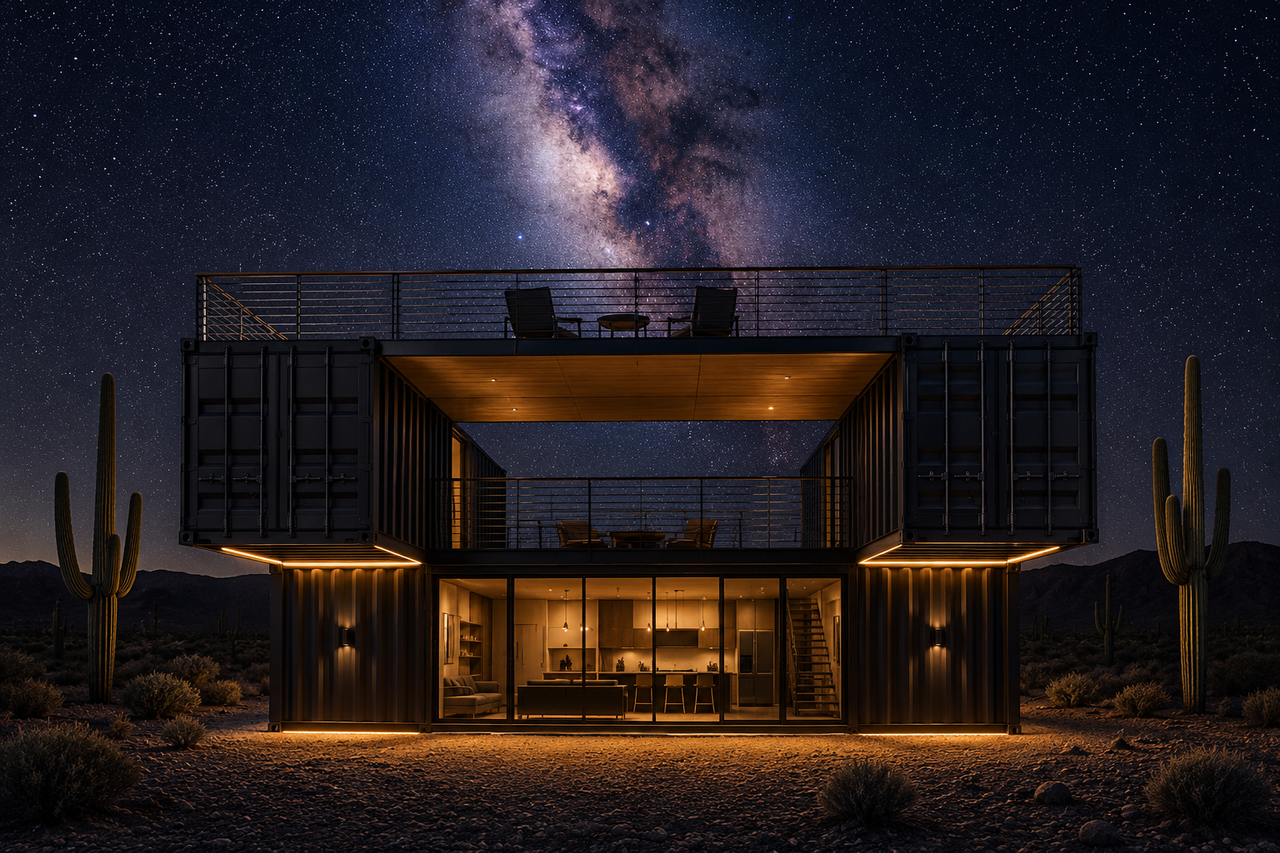
This new design takes everything that people liked about the original — two containers spread apart, the big enclosed common area in the middle, max space for minimum material — and doubles it. Stack two more containers on top, leave the gap between them open, throw a deck on the roof.
Now you've got a 4-bedroom, 2-bath, two-story house with a covered outdoor breezeway and a rooftop view deck.
Same DNA. Way more house.
The design: My off grid dream
Two 40' high-cube shipping containers on the ground, spaced 16 feet apart. The gap between them gets enclosed front and back with framed walls and big glass, and that becomes one giant open kitchen / dining / living room — about 640 square feet of common area with vaulted ceilings. The two ground-floor containers themselves hold two bedrooms and a bathroom.
Then you stack two MORE 40' containers directly on top of the first two, running the same direction. But this time you leave the gap between them open. That open space becomes a covered outdoor breezeway — sky above, the living room roof below, and you can walk straight through the second floor from one side of the house to the other.
The two upper containers hold two more bedrooms, the second bathroom, and whatever else you want — office, gym, whatever.
On top of all of that, you put a rooftop deck. Cable railing, wood top rail. That's your sunset spot, your stargazing spot, your morning coffee spot. About 1,280 square feet of rooftop.
Finished interior: 1,920 sqft. Total usable footprint with the breezeway and the deck: about 3,450 sqft.
For fifty grand.
Why this works
The original ranch worked because two shipping containers spread apart give you two structural walls for free. You don't have to frame them, you don't have to sheathe them — they're already there. You just span the gap with a roof.
Stacking works for the same reason. Shipping containers are designed to be stacked nine high on a cargo ship, full of freight, in the middle of the ocean. Two empty containers stacked on two more empty containers is nothing to them. The corner castings on top of the lower containers line up perfectly with the corner castings on the bottom of the upper containers — that's not a coincidence, that's the whole ISO standard.
You weld them at the corners, you're done. The structure is the structure.
The only real engineering challenge is the breezeway gap on the second floor. The two upper containers can't just float there — they need to be supported on each end. On one end they sit on top of the lower container. On the other end, same thing. The middle hangs in space, and that's fine, because a 40' container is a steel truss. It carries itself.
The rooftop deck is the easy part. Lay decking across the tops of the two upper containers with a small framed structure spanning the breezeway gap, add cable railing, done.
The four-bedroom layout
This is the part that actually matters to families.
Ground floor:
- Container 1 (left): bedroom, bedroom, bathroom, small utility closet
- Container 2 (right): bedroom, bedroom, mudroom/pantry
- Enclosed gap (640 sqft common area): kitchen along one container wall, dining and living open to the front glass wall
Upper floor:
- Container 3 (left, stacked on Container 1): master bedroom, full bathroom, walk-in closet
- Container 4 (right, stacked on Container 2): bedroom, office/loft, linen storage
- Open breezeway between them: 16' x 16' covered outdoor room
Roof:
- Full rooftop deck spanning the whole footprint with stairs up from the breezeway
You get into the house through the front glass wall into the common area. Stairs up to the breezeway sit on one side of the living room — you go up, you're outside under cover, and the two upper bedrooms open onto that breezeway. From the breezeway, another stair goes up to the deck.
It feels much bigger than 1,920 sqft because every room opens onto an outdoor space and every outdoor space is shaded.
Two siding options
This is the same house. Different skin.
Option 1: Adobe / stucco desert finish
Warm tan stucco over the containers. Insulation goes on the outside — straw-clay or rigid foam under the stucco — and that does two things. One, you keep all your interior square footage because the walls aren't eating two inches each side. Two, the thermal mass of the steel containers stays inside the insulation envelope, which means they absorb heat during the day and release it at night. In a desert climate that's huge. The house heats and cools itself half the time.
White trim around the windows. Flat parapet on the roof deck. Cable railing. Looks like a modern adobe pueblo from a distance and a $400k architect house up close.
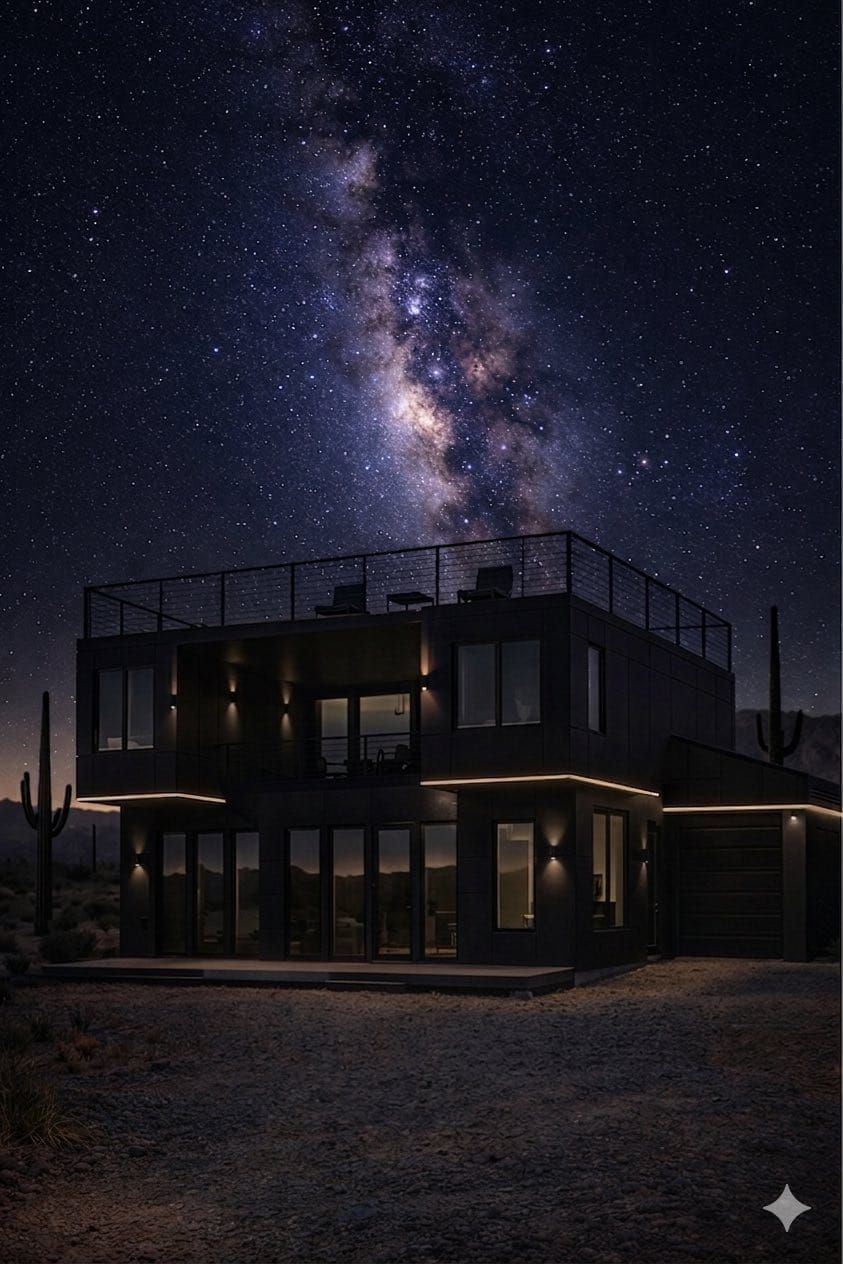
Option 2: Black metal modern
Leave the container corrugation showing. Paint it matte black or dark charcoal. Steel cable railing on the deck, raw wood top rail. Big black-framed windows. Maybe some warm wood accents around the entry and the breezeway.
Looks like a $600k Dwell Magazine cover house. Costs the same as the adobe version.
Both finishes work. Pick what fits your land and your climate.
The build cost — $50k, broken down
This is the lean, DIY-heavy version. You're doing the work, you're hiring help only where you have to.
Materials (≈ $22,000)
- (4) 40' high-cube containers, used cargo-worthy — $12,000 $3k each delivered local. Inspect for floor contamination and rust.
- Concrete piers / footings, rebar, sonotubes, PT sill plates, anchors — $1,200 12–16 piers, augered by hand or rented auger. Containers don't need a slab.
- Steel plates, angle, welding consumables, corner-casting hardware — $700 Stacking the upper containers means real welding at all eight upper corners.
- Front/back wall framing for the ground-floor common area — $1,400 2x6 walls, headers, sheathing.
- Big glass wall + front entry (insulated storefront or salvaged commercial) — $2,500 This is the wow factor of the common area. Worth the spend.
- Windows (10–12 vinyl sliders 36x36, plus 4 smaller bath/utility) — $1,800
- Roof / floor deck over the common area — $1,200 This is the second-floor structure spanning the gap. LVLs, joists, decking.
- Breezeway floor (above the common-area roof) — included above
- Rooftop deck — decking, joists over containers, parapet framing — $1,500
- Cable railing system (rooftop + breezeway + balcony) — $1,200 Stainless cable, posts, top rail. Goes a long way visually.
- Stairs — common area to breezeway, breezeway to deck (2 runs) — $800 Steel stringers or PT lumber stringers, treads.
- Siding package — $2,500 Option 1: stucco system + lath + mesh + base coat. Option 2: paint, primer, prep — leave corrugation showing.
- Sealants, primer, elastomeric for container seams and roof penetrations — $600
- Insulation (closed-cell spray foam interior OR rigid foam exterior) — $2,000
- Exterior doors (front entry, back service, breezeway access) — $600
Materials subtotal: ≈ $22,000
Non-labor costs (you pay these no matter what)
- Container delivery — 4 containers, tilt-bed or roll-off — $2,500 Distance-dependent. Stage them, set them with the crane on the same day.
- Crane day — set 2 upper containers + spot deck materials — $1,800 One day, one crane, one operator. Have everything ready before they arrive.
- Welder rental + consumables (if you don't own one) — $700
- Cutting tools — abrasive wheels, hole saws for steel, step bits — $500
- Equipment rentals — mag-drill, mixer, scaffold, lift if needed — $1,800
- Helper days — 2 people × 4–5 days at set and weld-out — $1,500 Cash/food. Just enough hands to be safe stacking 8,000 lbs of steel.
- Waste / dump fees / PPE / incidentals — $700
Non-labor subtotal: ≈ $9,500
Contracted work (the parts you probably shouldn't DIY)
- Crane operator + rigger — included above with crane day
- Certified welder for the eight upper corner welds + structural welds — $3,500 This is not the place to fake it. Pay a real welder for a day or two.
- Concrete crew for piers (if you don't pour your own) — $1,200
- Big glass wall install — $1,500 If salvaged, you can DIY. If new storefront, get it installed.
Contracted subtotal: ≈ $6,200
Rough-in (electrical + plumbing materials, DIY install)
- Electrical materials — main panel, branch wiring, boxes, devices, LED lighting — $3,000 Two floors means longer runs. Plan your chases through the container ribs.
- Plumbing materials — PEX supply, DWV, manifold, two bathrooms — $3,500 Two baths stacked vertically on the same wet wall saves you a fortune.
- Water heater (40-gal electric or small propane tankless) — $700
- HVAC — two mini-split heads, one outdoor unit (DIY-friendly system) — $2,200
Rough-in subtotal: ≈ $9,400
Contingency
- 10% buffer — $2,900
Grand total — dried-in shell with rough-in, ready for finish:
≈ $50,000
For a 4-bedroom, 2-bath, two-story house with a covered breezeway and a rooftop deck.
What this gets you and what it doesn't
This $50k builds the shell, rough-in, and dried-in structure. It does not build:
- Kitchen cabinets and countertops
- Bathroom finishes (tile, fixtures, vanities)
- Flooring
- Interior paint
- Appliances
- Septic / well
- Solar system
- Land
Plan another $15k–$25k for interior finish work depending on how nice you want it. Plan another $5k–$15k for septic depending on your soil. Plan whatever you plan for solar — I've written about that elsewhere and the short version is: LiFePO4 batteries, cheap panels, a 1–2kW wind turbine, AC inverter, regular appliances. Don't buy DC anything.
So your all-in livable house, off grid, sitting on land you already own lands somewhere around $70k–$90k. Still less than the down payment on a tract house in most cities.
Why the stack is worth the extra $25k over the ranch
The 2012 ranch is $25k for 1280 sqft on one floor.
This is $50k for 1920 sqft on two floors, plus 1,280 sqft of rooftop deck, plus 256 sqft of covered breezeway, plus four bedrooms instead of three, plus two bathrooms instead of one.
You're paying double, but you're getting roughly three times the usable space, and you only need half the land footprint to put it on. That matters if you're on a small parcel, if you want a view, if you want to keep more of your land wild, or if you just want a house that doesn't look like a single-wide.
The math is even better if you compare it to building site-built. A 4BR/2BA two-story conventional house in 2026 is running $300k to $500k depending on where you are. This is one-sixth of that on the low end.
A few things to know before you start
Permits and zoning. This is the part that kills more shipping container builds than anything else. Some counties love them. Some counties have never seen one and don't know what to do. Some have specific rules about minimum dwelling size, foundation types, and "permanent structure" definitions that container homes either sail through or get strangled by. Call your county planning office before you buy the containers. Not after.
Container quality. "Used cargo-worthy" is fine. "One-trip" or "new" is better and only a thousand or two more per container. Avoid containers with stained floors (chemical contamination), heavy rust at the rails, or bent corner castings. If you can, see them in person before you pay. Reputable yards will let you.
The eight upper welds matter. When you stack containers, the structural integrity of the whole house comes down to how those upper containers are tied to the lower containers. This is a real welder's job. Not a guy with a wire-feed from Harbor Freight who watched a YouTube video. Pay the certified welder. It's the cheapest insurance you'll ever buy.
The crane day is the most expensive day. Everything else can drag out. The crane can't. When the crane shows up, you'd better have your lower containers already set, your rigging plan worked out, your upper containers staged on the ground, and your welder ready to tack as soon as the first upper container is in position. Wasted crane hours are how a $50k build becomes a $55k build.
Insulation matters more than you think. Steel conducts heat like a frying pan. In summer that container will hit 130°F inside if it's not insulated. In winter it'll freeze your pipes. Spray foam the interior or stucco the exterior — pick one, do it well, don't skip it.
This is the upgrade the 2012 design needed
That ranch was for one person or a couple. This is for a family. Or a couple who wants room. Or one person who wants to host. Or anyone who's been priced out of the regular housing market and is staring at fifty grand in savings wondering what it can actually buy.
It can buy this.
Not a trailer. Not a tiny house. A real four-bedroom, two-bath, two-story house with a view deck and an outdoor room, built out of steel boxes that were going to get scrapped anyway.
Less than the price of the truck you'd haul the containers in with.
Eric
This is another original design by Eric Wichman. Like the 1280 ranch, this design is licensed under Creative Commons Share and Share Alike Non-Commercial — build it, share the plans, just give credit and link back.
Disclaimer: This is a 3D design concept. Pricing is for bare-bones materials, rough-in, and structural shell. Does not include freight if delivery is over local distance, land, septic, well, solar, interior finishes, or appliances. Permits and code compliance vary by jurisdiction.
Dear Reader,
I would greatly appreciate your support to help me create more content like this. My mission is to help folks on their journey to go off grid through educational and informative, and sometimes entertaining articles and essays about off grid living and survival.
You can support the mission by subscribing to my off grid magazine here: Off Grid Living & Survival magazine Lifetime Membership Only $49 + ALL BACK ISSUES FREE
Thank you!
Sincerely, Eric
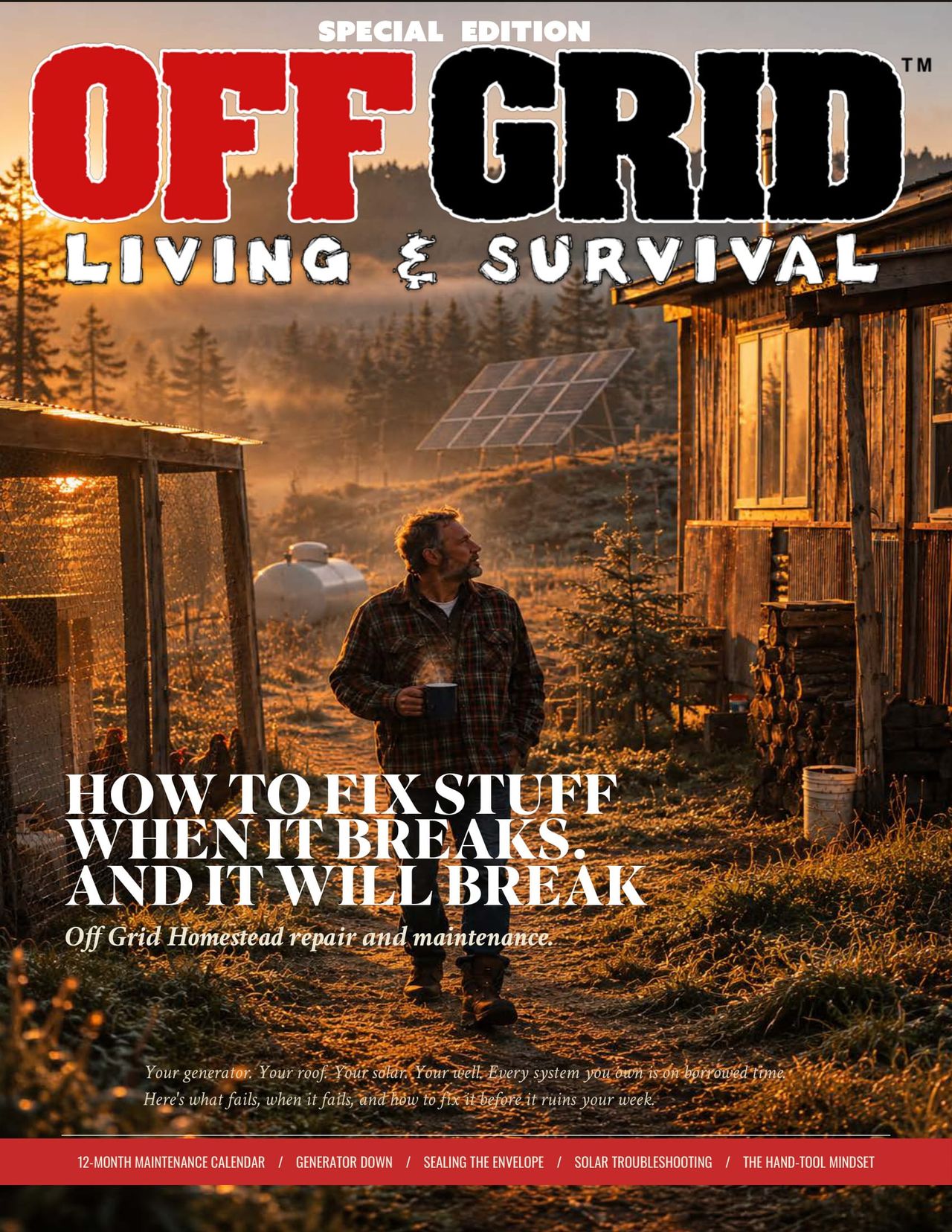
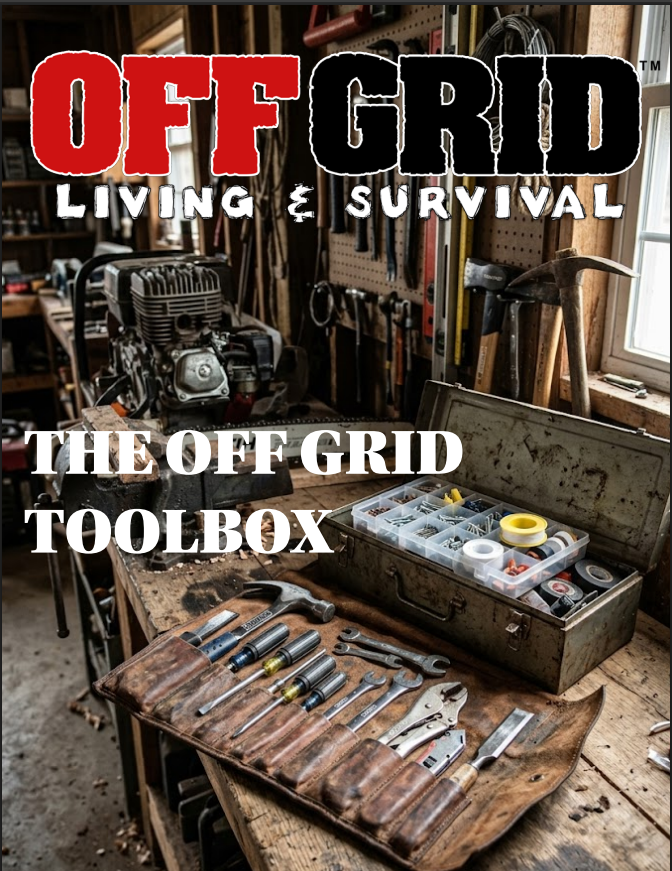
The three newest issues just dropped — Critter Proof Your Off Grid Homestead, How To Fix Stuff When It Breaks (And It Will Break), and The Off Grid Toolbox. They're up on the site right now, along with all 45 back issues. $49 lifetime membership gets you every single one, plus every future issue I publish.

https://www.offgridlivingsurvival.com/off-grid-living-survival-magazine/
If you want to help me keep fighting, any amount through these links moves us forward:
Stripe: https://donate.stripe.com/bIYdUHbOj4Su4Ao6op Venmo: https://venmo.com/u/EricWichman CashApp: https://cash.app/$EricWichman PayPal: https://www.paypal.me/EricWichman1
Monthly: $20, $10, or $5 — whatever works.
One last thing. I've been working on something for over a year now. An idea I've had for a while that's finally coming together. When it's ready, I'm bringing in a select few to help shape it.
They tried to shut me down. They failed.
Eric